
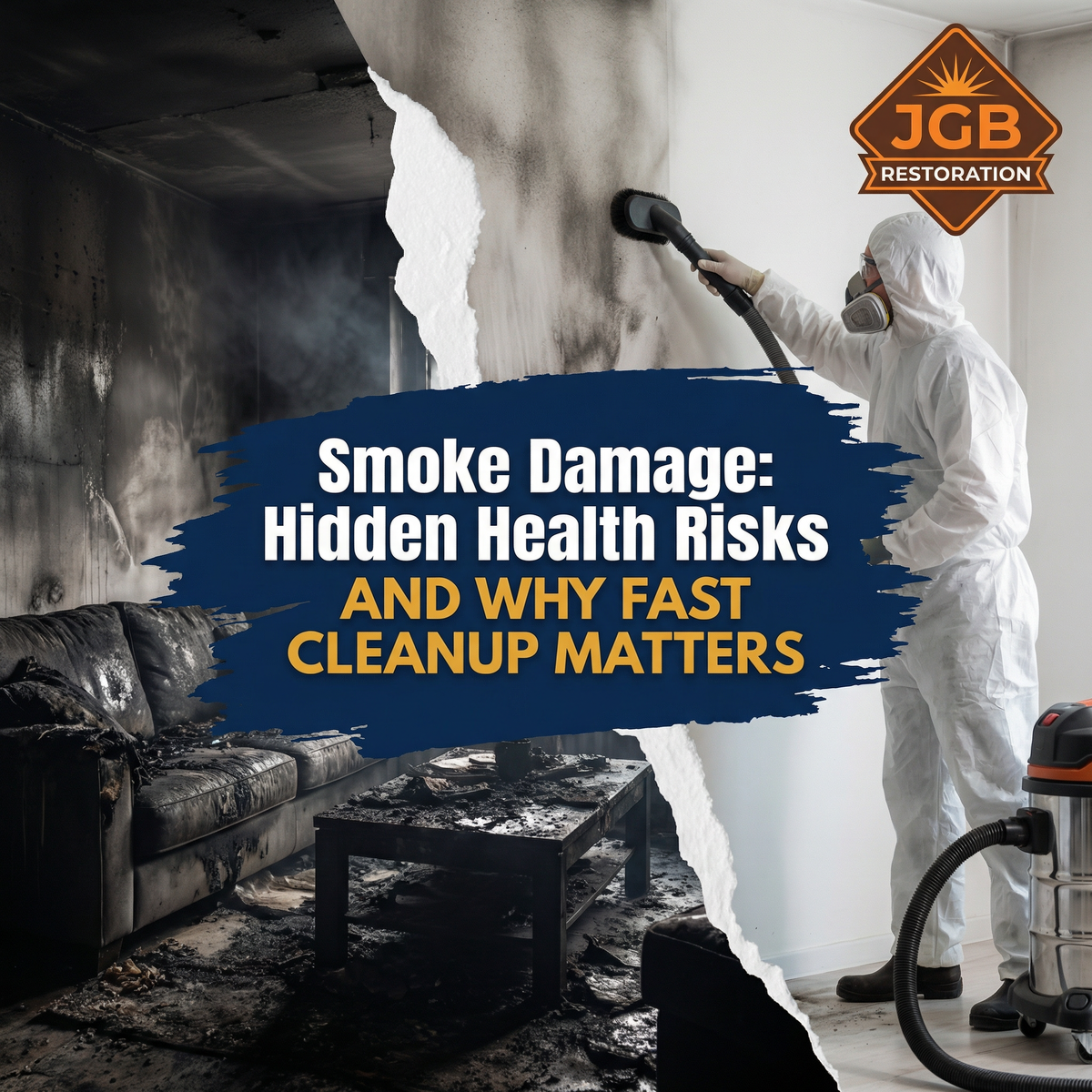
When a fire is extinguished, most people assume the danger is over. The flames are out, the firefighters have left, and the immediate crisis has passed. What many Orange County homeowners do not realize is that the health risks from a fire often intensify in the hours and days after the fire itself. Smoke damage is not just a cosmetic problem, it is a chemical contamination event that affects the air quality, surfaces, and structural materials of your home in ways that are not visible to the naked eye.
Understanding what smoke damage actually is, what it does to the people inside a home, and why professional cleanup is the only reliable solution can help you make better decisions in the aftermath of a fire, decisions that protect your family's health and your property's long-term value.
The Quick Answer
Is it safe to stay in a smoke-damaged home? No. Even after a fire is extinguished, a smoke-damaged home contains elevated levels of carbon particles, volatile organic compounds (VOCs), formaldehyde, polycyclic aromatic hydrocarbons (PAHs), and other toxic substances that pose serious respiratory and systemic health risks. These compounds penetrate porous surfaces and continue off-gassing for weeks or months. Until professional remediation has been completed and air quality testing confirms safe levels, a smoke-damaged home is not safe for occupancy, particularly for children, elderly individuals, or anyone with respiratory conditions.
What Smoke Damage Actually Is
The word "smoke" suggests something temporary, a visible cloud that disperses when the air clears. The reality of smoke damage is far more persistent and chemically complex.
When materials burn, they release a mixture of combustion byproducts that include solid particles, liquid droplets, and gases. The solid particles, commonly called soot, consist of carbon and partially burned organic compounds that are small enough to remain suspended in air for extended periods and small enough to penetrate deep into the respiratory system when inhaled. These particles settle on every surface in the affected space, including inside HVAC ductwork, inside wall cavities accessed through electrical outlets and vents, and on the surfaces of personal belongings throughout the home.
The gaseous components of smoke include carbon monoxide, carbon dioxide, formaldehyde, benzene, toluene, and dozens of other volatile organic compounds. Many of these gases are absorbed by porous materials — drywall, wood, fabric, carpet, insulation, and continue releasing back into the air long after the fire is out. This off-gassing process can continue for weeks or months, maintaining elevated indoor air pollution levels in a home that appears clean.
The specific chemical composition of smoke depends on what burned. House fires typically involve a mixture of building materials, furniture, synthetic fabrics, plastics, and household chemicals. Each material produces its own combustion byproducts, and the combination creates a complex chemical mixture that is more hazardous than any single component.
The Health Risks of Smoke Exposure in Your Home
The health effects of smoke exposure in a damaged home range from immediate irritation to serious long-term consequences, depending on the concentration of contaminants, the duration of exposure, and the individual's health status.
Respiratory effects are the most immediate and common. Soot particles and smoke gases irritate the mucous membranes of the nose, throat, and lungs. Short-term exposure causes coughing, wheezing, shortness of breath, and eye irritation. For individuals with asthma, chronic obstructive pulmonary disease (COPD), or other respiratory conditions, even brief exposure to smoke-contaminated air can trigger serious exacerbations.
Cardiovascular effects are less obvious but equally concerning. Fine particulate matter from smoke, particles smaller than 2.5 micrometers, known as PM2.5, can penetrate deep into the lungs and enter the bloodstream. Research has linked elevated PM2.5 exposure to increased risk of heart attack, stroke, and cardiac arrhythmia. These effects are particularly significant for older adults and individuals with existing cardiovascular conditions.
Toxic chemical exposure from the VOCs and PAHs present in smoke residue creates risks that extend beyond the respiratory system. Benzene, a known carcinogen present in smoke from many common household materials, is absorbed through both inhalation and skin contact with contaminated surfaces. Formaldehyde, another common smoke component, is a respiratory irritant and probable carcinogen. These compounds do not disappear when the smoke clears, they remain in surface residues and continue to be absorbed by anyone spending time in the space.
Neurological effects from carbon monoxide exposure can persist even after CO levels normalize. Carbon monoxide binds to hemoglobin more effectively than oxygen, reducing the blood's oxygen-carrying capacity. Exposure to elevated CO levels, which are common in the immediate aftermath of a fire, can cause headaches, dizziness, confusion, and in severe cases, permanent neurological damage.
How Smoke Travels and Hides in a Structure
One of the most important things to understand about smoke damage is that it does not stay where the fire was. Smoke is a gas-particle mixture that follows air pressure differentials, and during a fire, those differentials drive smoke throughout the entire structure, not just the rooms adjacent to the fire.
Smoke travels through HVAC ductwork, distributing soot and chemical residues to every room served by the system. It penetrates electrical conduits, plumbing chases, and the gaps around pipes and wires where they pass through walls and floors. It enters wall cavities through outlet boxes and switch plates. It infiltrates attic spaces through ceiling penetrations and can contaminate insulation throughout the home.
This means that a fire in one room of a house can leave smoke residue in every room, including rooms that show no visible signs of damage. The kitchen that looks untouched after a fire in the living room may have elevated levels of VOCs and soot on every surface, inside every cabinet, and throughout the HVAC system.
Professional smoke damage assessment accounts for this reality by testing air quality throughout the structure, not just in the affected area. Thermal imaging can reveal smoke penetration in wall cavities. HVAC inspection identifies contamination in the ductwork. This comprehensive approach ensures that remediation addresses the full scope of contamination rather than just the visible damage.
Why Smoke Smell Does Not Mean Smoke Is Gone, And Why It Does Not Mean Smoke Is Present Either
The smell of smoke is one of the most persistent and psychologically distressing aspects of fire damage. It permeates fabrics, penetrates porous materials, and can linger in a home for months after a fire. But the relationship between smoke smell and smoke contamination is more complicated than it might seem.
Smoke odor is caused primarily by the VOCs and other gaseous compounds that continue off-gassing from contaminated surfaces. The presence of a strong smoke odor indicates ongoing off-gassing and, by extension, ongoing chemical exposure. Eliminating the odor requires eliminating the source, the contaminated materials — not just masking it with air fresheners or ozone treatments.
Conversely, the absence of smoke smell does not mean a space is safe. Some of the most hazardous components of smoke residue are odorless. Carbon monoxide is famously odorless. Many VOCs have odor thresholds well above their health-hazard thresholds, meaning they can be present at dangerous concentrations without producing a detectable smell. Air quality testing, not the smell test, is the only reliable way to confirm that a smoke-damaged space is safe for occupancy.
What Professional Smoke Remediation Involves
Effective smoke remediation is a multi-step process that addresses contamination at every level, surfaces, contents, air, and structure. It is not cleaning. It is decontamination.
The process begins with a comprehensive assessment that identifies all affected areas, including those not visible to the naked eye. Air quality testing establishes baseline contamination levels. Moisture readings identify any water damage from firefighting efforts that must be addressed simultaneously.
Containment is established to prevent cross-contamination during the remediation process. HVAC systems are shut down and sealed to prevent the spread of disturbed contaminants. Affected areas are isolated from unaffected areas.
Structural cleaning involves the removal of soot and smoke residue from all surfaces using appropriate cleaning agents and methods. Different surfaces require different approaches, dry sponge cleaning for some materials, chemical sponge cleaning for others, and media blasting for severe structural contamination. This is not a process that can be accomplished with household cleaning products.
Contents cleaning addresses personal belongings, furniture, clothing, and other items that have been contaminated. Some items can be cleaned and restored; others must be disposed of. The determination requires professional assessment, as items that appear clean may retain chemical contamination.
HVAC remediation involves cleaning or replacing ductwork, coils, and other components that have been contaminated by smoke. A contaminated HVAC system will continue to distribute smoke residue throughout the home every time it operates, undermining any surface cleaning that has been done.
Odor elimination through thermal fogging, hydroxyl generation, or ozone treatment addresses residual odor-causing compounds after surface cleaning is complete. These treatments are most effective as a final step after thorough surface remediation, not as a substitute for it.
Vulnerable Populations: Who Is Most at Risk
While smoke damage poses health risks to everyone, certain groups face significantly elevated risk from exposure to smoke-contaminated environments.
Children are particularly vulnerable because their respiratory systems are still developing, they breathe more air relative to their body weight than adults, and they spend more time on floors and other surfaces where soot settles. Children with asthma face the additional risk of severe exacerbations from smoke exposure.
Elderly individuals face elevated risk from both the respiratory and cardiovascular effects of smoke exposure. Reduced lung capacity, existing cardiovascular conditions, and compromised immune function all increase vulnerability.
Pregnant women face risks to both themselves and their developing fetuses. Several compounds present in smoke residue, including PAHs and VOCs, have been associated with adverse pregnancy outcomes including preterm birth and developmental effects.
Individuals with asthma, COPD, or other respiratory conditions face the risk of serious exacerbations from even brief exposure to smoke-contaminated air. For these individuals, a smoke-damaged home is genuinely dangerous, not merely unpleasant.
Orange County Wildfire Smoke vs. Structure Fire Smoke
Orange County homeowners face two distinct types of smoke damage risk: damage from structure fires within the home and smoke infiltration from wildfires burning in the region. These two types of smoke damage have different characteristics and require different responses.
Structure fire smoke, as described throughout this article, involves the combustion of building materials, furniture, and household contents. It produces concentrated contamination in the immediate area and throughout the structure via air movement.
Wildfire smoke infiltrates homes from the outside, carrying combustion byproducts from burning vegetation, structures, and vehicles over large areas. While typically less concentrated than structure fire smoke inside a home, wildfire smoke can still deposit significant particulate matter and VOCs on interior surfaces during extended smoke events. Orange County's proximity to wildfire-prone areas in the Santa Ana Mountains, the Laguna Hills, and the Cleveland National Forest makes this a recurring concern.
After a significant wildfire event, even homes that were not directly threatened may benefit from air quality testing and HVAC filter replacement. Homes that experienced visible smoke infiltration, detectable by the smell of smoke inside, should be assessed for surface contamination, particularly in homes with older, less air-tight construction.
Dealing with smoke damage in your Orange County home? JGB Restoration provides comprehensive smoke damage assessment and remediation services throughout Orange County. Call (949) 339-3292, we respond within 60 minutes for emergency situations, 24 hours a day, 7 days a week. Our certified technicians will assess the full scope of contamination and develop a remediation plan that makes your home safe again.
JGB Restoration serves all of Orange County including Huntington Beach, Newport Beach, Irvine, Anaheim, Costa Mesa, Santa Ana, Laguna Beach, Dana Point, San Clemente, and surrounding communities. License #1037873.


.png)
.png)